

We will see the simulation of qualifying Leclerc, Hamilton and Norris:
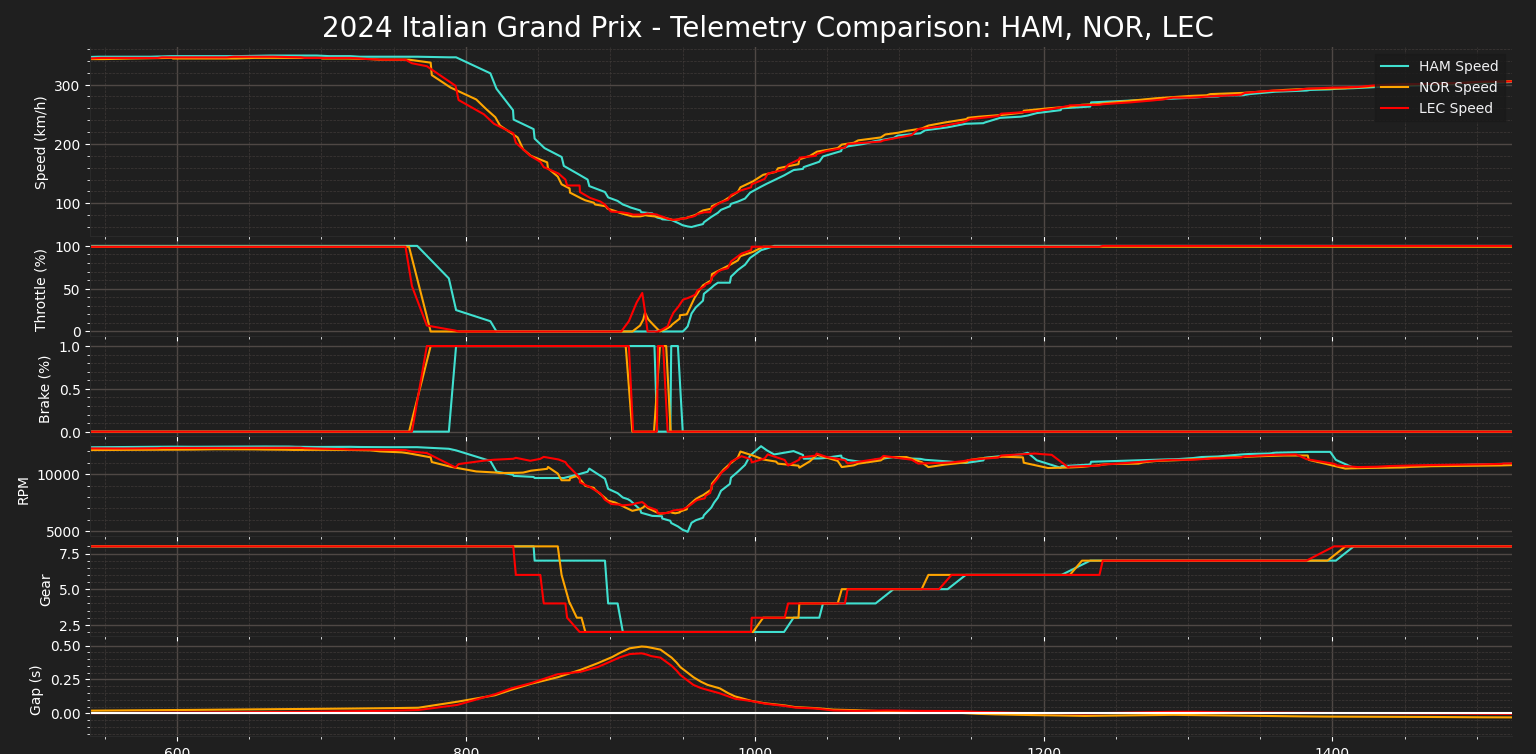
We arrive at turn 1, where the internal curbs are now much lower than those of the previous edition, Hamilton reaches 347 km/h, while Leclerc and Norris only 342 km/h, 5 km/h difference.
Hamilton gradually raises the pedal and brakes much later, but he will need more time to get his tyres back in line and start again. Norris and Leclerc take it in a similar way, with the only difference that the Monegasque climbs the gears progressively, while Norris is more aggressive and immediately goes from eighth to second gear. Leclerc manages to get a better exit than that of Norris.
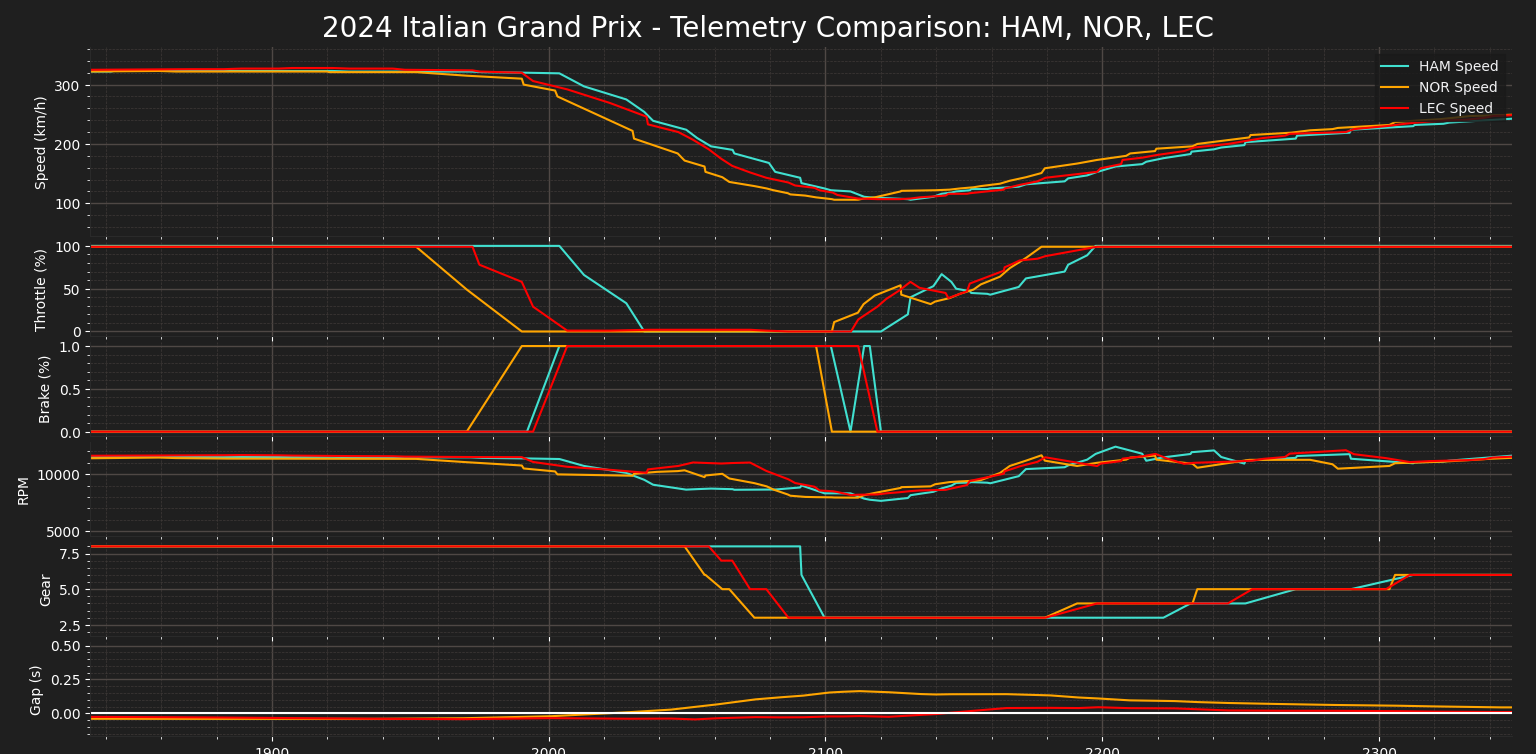
At the end of the straight leading to the first chicane, Leclerc reached a higher speed than his rivals, 325 km/h against 322 by Hamilton and 321 by Norris. Here, the first to slow down will be the driver n°4, who prefers to optimize the output over the speed in. The opposite of Hamilton.
Norris is the best to get out of the corner.
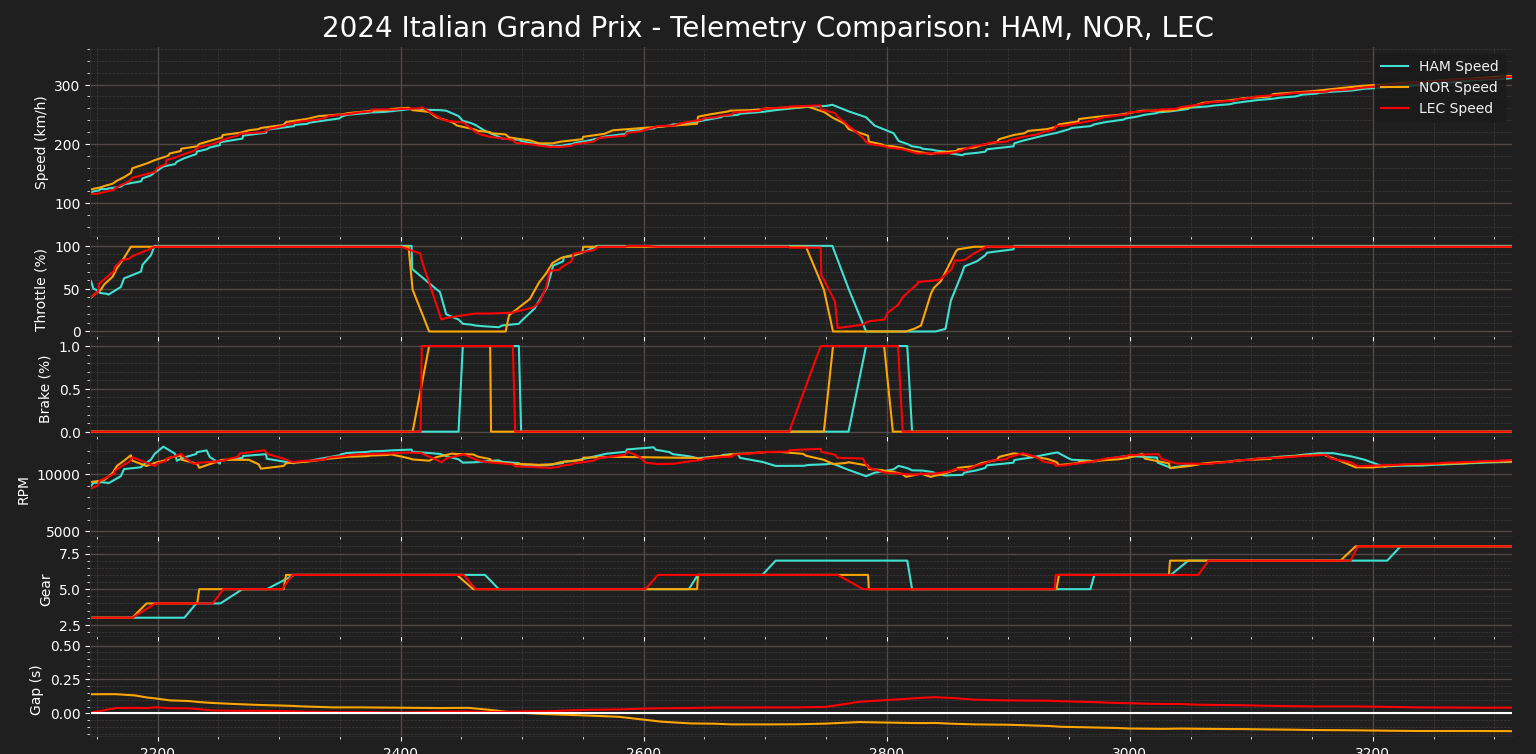
After the first chicane we find the wonderful Lesmo 1 and Lesmo 2. In the first Norris prefers to raise the pedal from the accelerator, and start braking earlier, but less aggressive than Leclerc, who faces the curve without raising his foot completely from the accelerator, Hamilton also approaches it in this way, but he has to raise more.
Norris doesn’t get much out of it. We arrive at Lesmo 2, to brake first and in a less aggressive way is Leclerc, who steers with precision and waits for the right moment to press the accelerator. And here the number 16 accelerates already in half of the curve.
Leclerc succeeds in his intent, but to side him there is Hamilton, both record an EOSS of 337 km/h, probably n°16 has used the energy of its ERS to discharge all the power in exit of turn 7, While the n°44 will have used the energy of its electric motor during the straight.
Norris has an EOSS of 335 km/h. But at the exit of the Ascari, Leclerc needs to raise the pedal by 6% from the accelerator in order not to lose control of the car, a probable oversteer or a driver error.
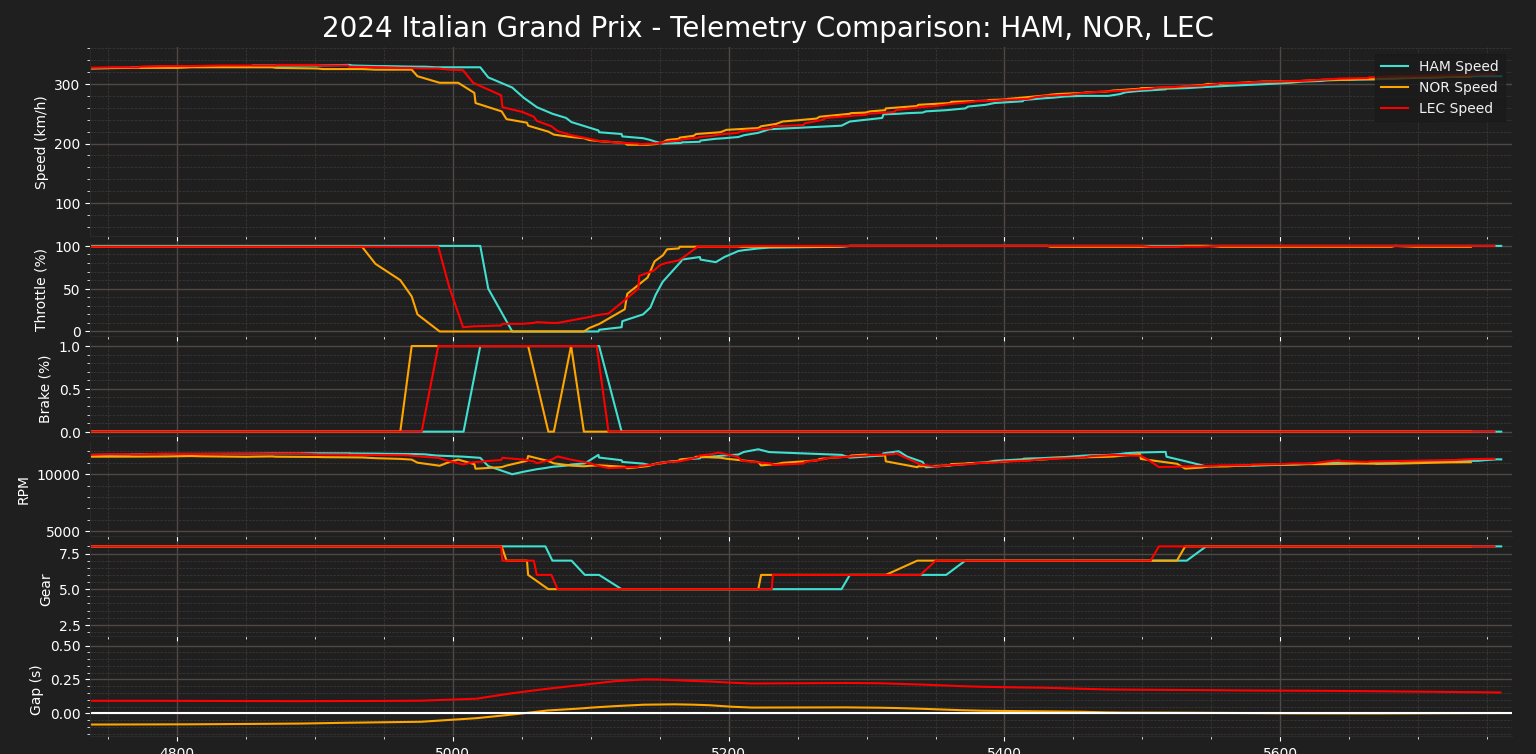
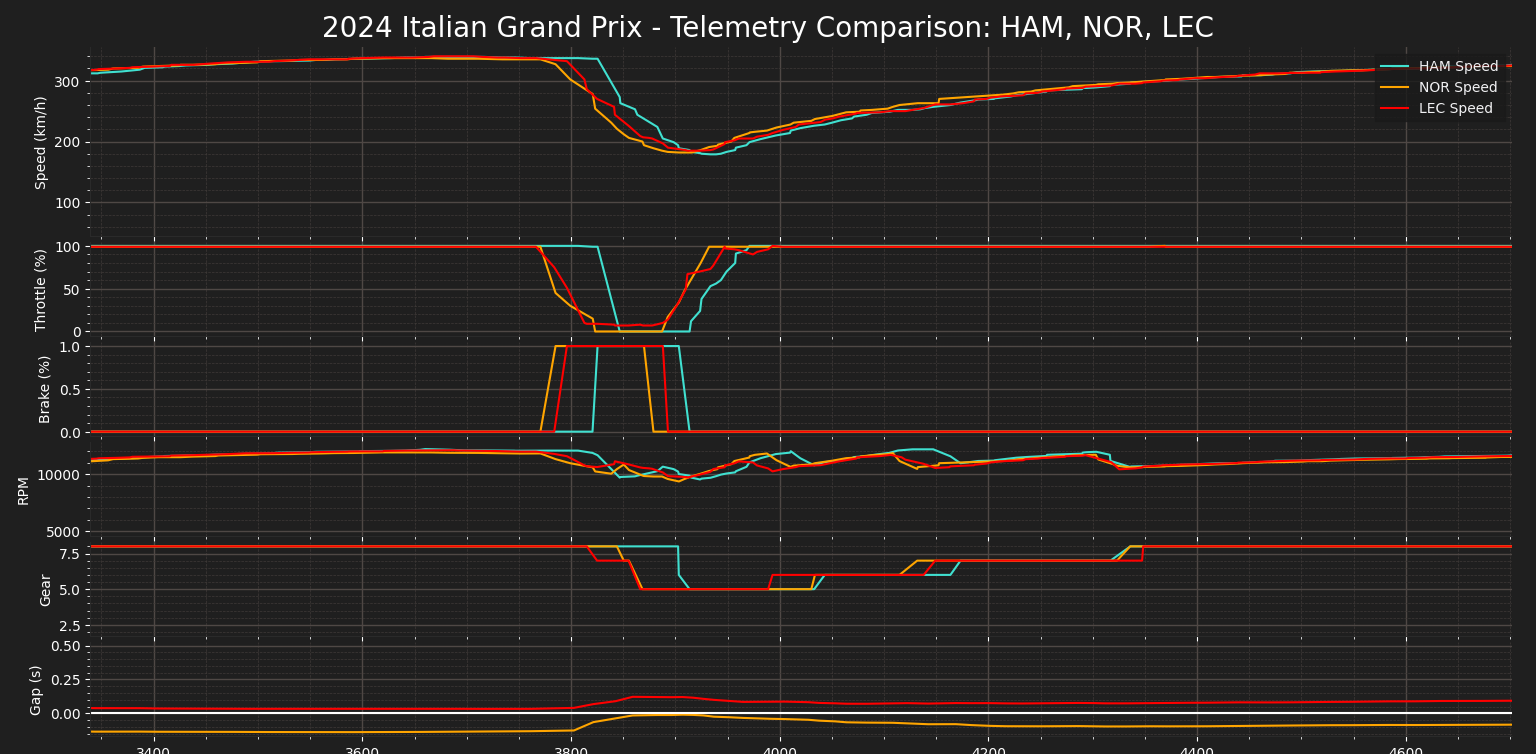
Hamilton arrives at the parabolic with 330 km/h, immediately after there is Leclerc with 329 and then Norris with 325 km/h. The straight after at the parabolic is the main, the most important one, where you reach the highest km/h and it is important to have an excellent traction in exit.
Norris knows it well and therefore decides to slow down progressively and at the same time to brake, to bring itself in turn 11 in a good way to start as soon as possible and better. Immediately after to follow him there is Leclerc who slows and brakes at the same time. Hamilton as we have seen several times has a setup that prefers the entry in the curve, compromising a little’ exit.
Leclerc is the only one to tackle the parabolic with a little pedal pressed, while the two British raise it completely. But even so, Norris manages to come out slightly better than the Monegasque who follows him immediately afterwards.
We arrive at the end of the lap, on the finish line, with Leclerc at 317 km/h, 313 km/h Hamilton and 312 km/h Norris.
But the fastest lap was Hamilton with a time of 1:20.738, Norris with 1:20.741 and Leclerc with 1:20.892
These are just the tests and the teams are still hiding their true potential, but we saw their technique in the dry lap and how it diversifies between three different teams!


